
Understanding OD600
A Practical Guide for Measuring Microbial Growth
What Is OD600?
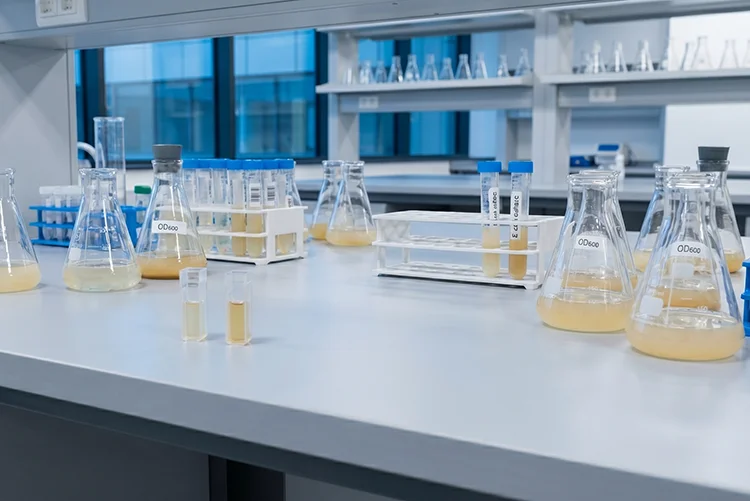
Optical density at 600 nm (OD600) is one of the most widely used methods for monitoring microbial growth in liquid cultures. Researchers commonly use OD600 measurements to estimate cell density and track the growth of bacteria, yeast, and other microorganisms over time.
OD600 measurements are especially useful for:
- Monitoring culture growth
- Determining when cells enter different growth phases
- Identifying the optimal time for induction in protein expression experiments
- Determining when cultures should be harvested
- Comparing growth under different experimental conditions
How OD600 Works
When a beam of light at 600 nm passes through a microbial culture, cells in suspension scatter and reduce the amount of light reaching the detector. The instrument reports this reduction as optical density (OD).
As cell density increases, more light is scattered, resulting in a higher OD600 value.

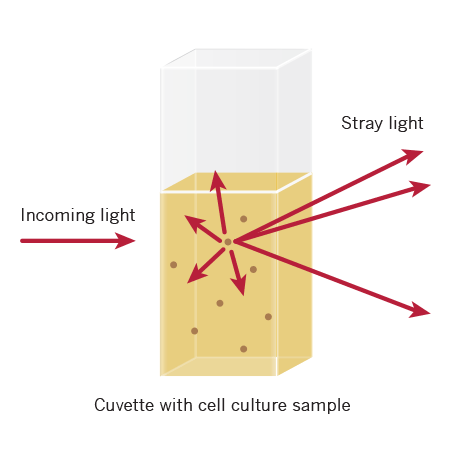
Although OD600 is often used as a proxy for cell concentration, it does not directly count cells. Instead, it provides an indirect estimate of biomass or culture turbidity.
Several factors can influence an OD600 measurement, including:
- Cell concentration
- Cell size and shape
- Cell aggregation
- Dead cells and cellular debris
- Instrument design and optical configuration
Using OD600 to Monitor Growth Phases
Microbial cultures typically progress through four major growth phases:
Lag Phase
Cells adapt to their new environment and prepare for growth. Cell division is minimal, and OD600 changes little.Log (Exponential) Phase
Cells divide rapidly at a relatively constant rate. OD600 increases steadily and predictably.Stationary Phase
Growth slows as nutrients become limited and waste products accumulate. Cell division and cell death occur at similar rates.Decline Phase
Cell death exceeds cell growth, and culture viability decreases.
Many experimental protocols target cells during the late log phase because cultures are metabolically active and physiologically consistent at this stage.



Good decisions in microbial workflows depend on understanding growth, not just measuring it. OD600 provides a fast, reliable way to monitor culture density and identify the right moment for induction, sampling, or harvest.
The Beer-Lambert Law and Its Relationship to OD600
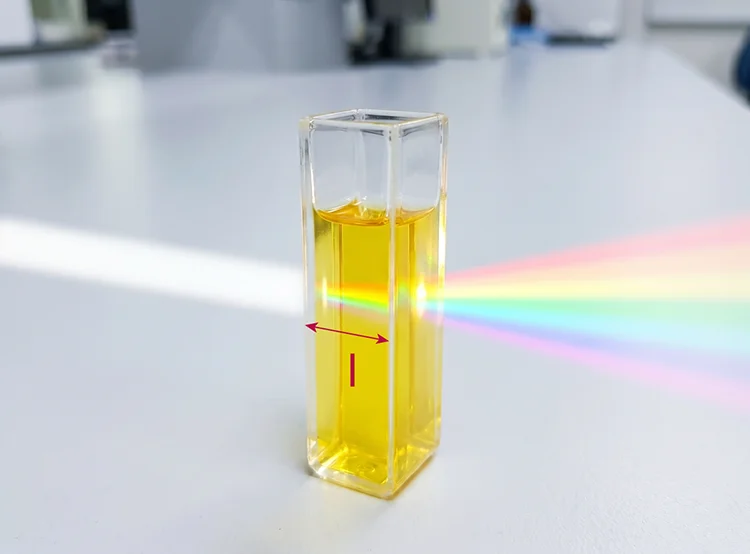
The Beer-Lambert Law describes how light absorption relates to the concentration of an absorbing substance:
A = ε × c × l
- A = absorbance
- ε = extinction coefficient (molar absorptivity)
- c = concentration
- l = optical path length
However, microbial cultures behave differently. Most of the signal measured during OD600 experiments arises from light scattering, not true molecular absorption. Because of this, the Beer-Lambert Law is only approximately applicable to cell suspensions and is most reliable at relatively low cell densities.
At high densities, multiple scattering events can occur, causing the relationship between OD600 and cell concentration to become increasingly non-linear.
Best Practices for Reliable OD600 Measurements
Mix Cultures Thoroughly
Cells can settle quickly in suspension. Always mix samples immediately before measurement to ensure a uniform distribution of cells.Use Consistent Sample Handling
Maintain consistent procedures for sample collection, dilution, and measurement throughout an experiment.Blank the Instrument Properly
Use the same growth medium without cells as the blank to account for background absorbance and scattering.Choose Appropriate Sample Volumes
Larger sample volumes generally provide more representative measurements because they average variability within the culture.Measure at Similar Time Points
When comparing growth conditions, collect measurements at consistent intervals to generate meaningful growth curves.Key Takeaways
- OD600 is a rapid and widely used method for monitoring microbial growth.
- The measurement primarily reflects light scattering rather than true absorbance.
- OD600 provides an estimate of cell density but does not directly count cells.
- Different instruments may produce different readings for the same culture.
- Calibration curves are essential when accurate cell concentration measurements are required.
- Measurements are most reliable within the instrument’s linear range.
- Proper sample handling, mixing, and dilution practices are critical for obtaining reproducible results.