
RNA Quantification
Concentration • Purity • Quality
RNA Quantification Using UV Spectroscopy
By analyzing absorbance at 260 nm and comparing absorbance ratios at additional wavelengths, researchers can quickly evaluate RNA samples and make better decisions before moving on to critical downstream steps.
This page explains how RNA quantification using UV spectroscopy works, what A260 means, how purity ratios are interpreted, what can affect accuracy, and how UV-Vis measurements fit into a typical laboratory workflow.
How RNA Quantification Works, Purity Ratios, RNA Concentration Formula
Why RNA Quantification Matters
RNA concentration can directly influence the quality, efficiency, and reproducibility of downstream experiments. If a sample is too dilute, it may not provide enough template for the intended application. If it is too concentrated, it may require normalization before use.
Just as importantly, a sample can have an acceptable RNA concentration while still containing contaminants that interfere with enzymes, amplification reactions, or sequencing performance.
- Ensure consistent input for PCR and qPCR
- Normalize samples for sequencing workflows
- Evaluate extraction success
- Identify possible contamination before investing time in downstream work
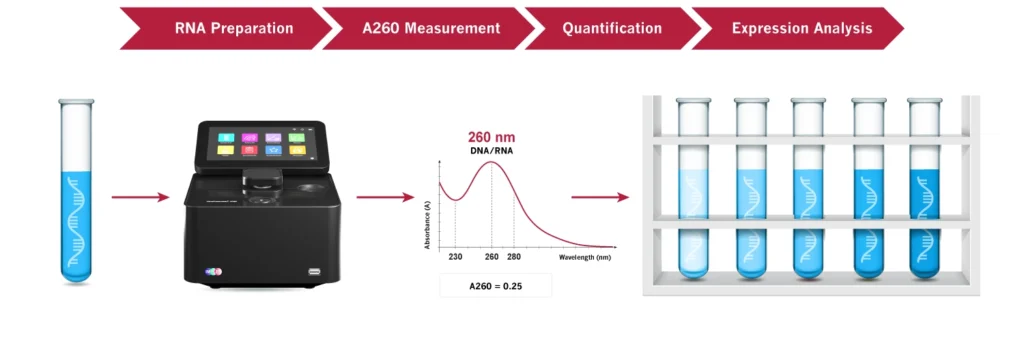
Typical RNA measurement workflow from extraction to A260 measurement and downstream applications such as PCR and sequencing.
Because RNA analysis often sits near the beginning of a workflow, the quality of this step can affect everything that follows.
Fast and accurate quantification can therefore save time, reduce failed experiments, and improve data quality.
How RNA Quantification Works in UV Spectroscopy
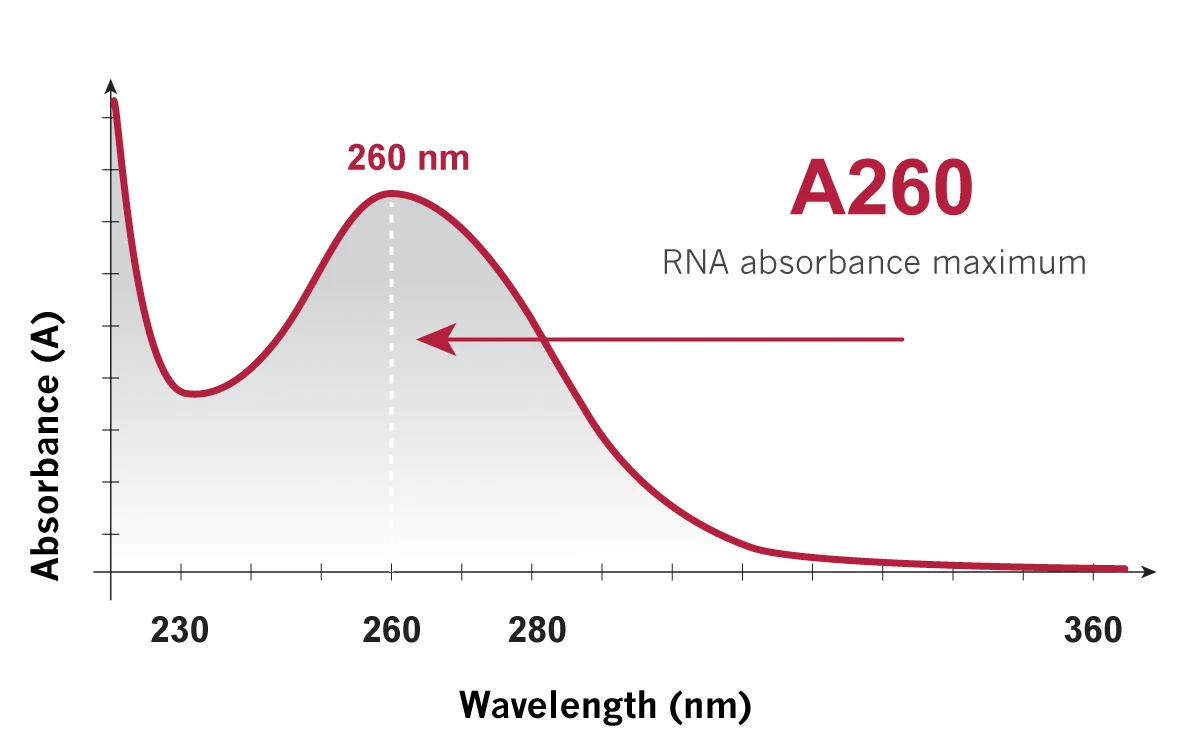
RNA absorbs ultraviolet light strongly at 260 nm due to its nucleotide bases. The absorbance measured at this wavelength is directly proportional to RNA concentration and can be used for rapid quantification without additional reagents.
This relationship is described by the Beer-Lambert law, which connects absorbance to concentration, path length, and extinction coefficient.
In practical laboratory use, a spectrophotometer measures absorbance at 260 nm and converts that absorbance into an RNA concentration value using established conversion factors.
For nucleic acids, the commonly used conversion factors are:
- 1 A260 = 40 µg/mL for RNA
- 1 A260 = 50 µg/mL for double-stranded DNA
- 1 A260 = 33 µg/mL for single-stranded DNA
These conversion factors allow rapid determination of concentration from an absorbance reading. In many workflows, this means a researcher can place a microvolume sample onto the pedestal or load a cuvette, run the measurement, and immediately obtain a concentration result without additional reagents or incubation steps.

What Is A260?
A260 refers to the absorbance of a sample measured at 260 nm. For RNA quantification, this is the key wavelength because nucleic acids have their absorbance maximum in this region.
A higher A260 value generally indicates a higher nucleic acid concentration, assuming the sample is free from major contaminants and the measurement is performed correctly. The absorbance value itself is not the final result. Instead, the instrument uses that absorbance together with the known path length and conversion factor to calculate concentration.
In practical terms, A260 provides the foundation for RNA quantification, while additional wavelength measurements help researchers evaluate purity.
RNA Concentration Calculation
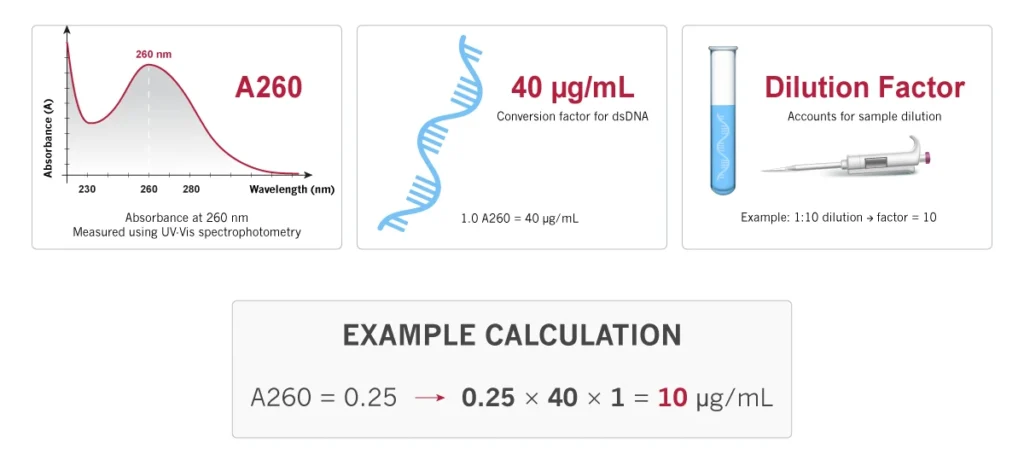
RNA concentration is determined from absorbance at 260 nm using UV-Vis spectroscopy, based on the Beer-Lambert law.
For RNA, the standard convention is:
RNA concentration = A260 × 40 µg/mL × dilution factor
For example, if an RNA sample produces an A260 of 0.25 and was measured without dilution, the estimated concentration is: 0.25 × 40 µg/mL = 10 µg/mL
If the sample was diluted prior to measurement, the dilution factor must also be included in the calculation.
Modern spectrophotometers typically perform this calculation automatically, but it is still useful for researchers to understand the principle behind the reported concentration value.
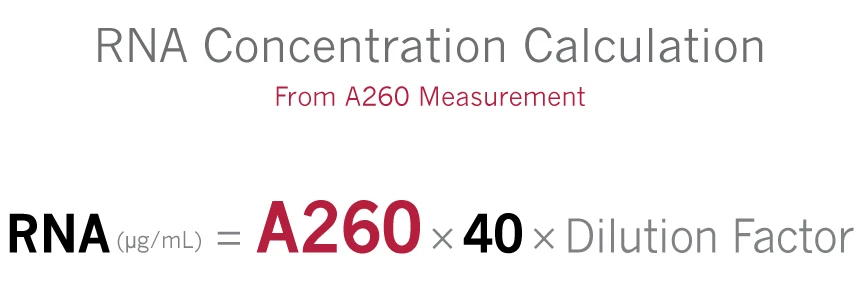


RNA concentration is calculated from A260 using established conversion factors based on the Beer-Lambert law.
For DNA, use 50 µg/mL per A260 unit.
Assessing RNA Purity with UV Absorbance Ratios
260/280 Ratio
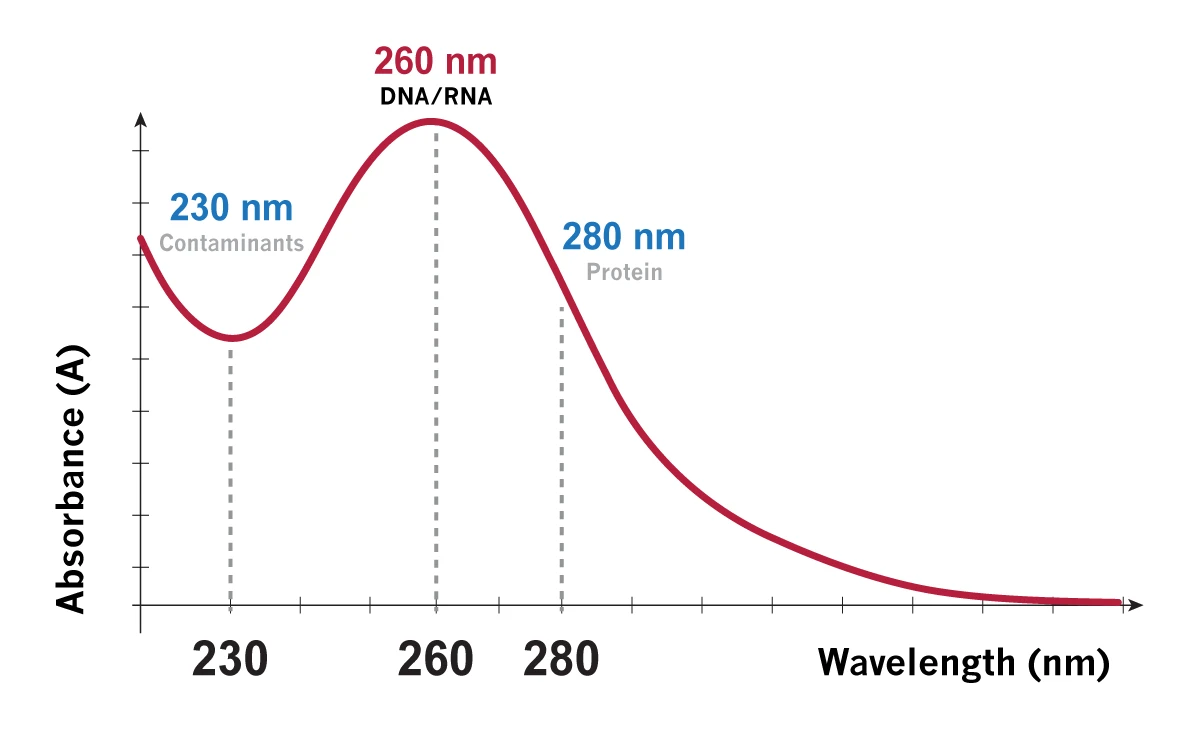
The 260/280 ratio is used primarily to assess possible protein contamination. Proteins absorb more strongly at 280 nm, while nucleic acids absorb more strongly at 260 nm. By comparing these two absorbance values, researchers can estimate whether protein or phenolic contamination may be affecting the sample.
For pure RNA, a 260/280 ratio of approximately 2.0 is generally considered acceptable.
A lower ratio may suggest:
- Protein contamination
- Phenol carryover
- Other UV-absorbing impurities
A higher ratio can occur in some cases due to measurement artifacts, blanking issues, or unusual sample composition.
260/230 Ratio
The 260/230 ratio is often used as a secondary purity indicator. It can help identify contamination from compounds that absorb around 230 nm, such as salts, carbohydrates, guanidine, EDTA, or residual organic reagents from extraction procedures. For many pure RNA samples, a 260/230 ratio in the range of about 2.0 to 2.2 is considered desirable. A low 260/230 ratio may suggest:- Chaotropic salt contamination
- Residual extraction reagent carryover
- Organic compounds
When UV Spectroscopy Is Especially Useful for RNA Analysis
- Fast results without reagent preparation
- Concentration and purity information in a single measurement for routine RNA quality control
- A practical method for PCR, gene expression analysis, cDNA synthesis, and sequencing preparation
- Microvolume measurement for limited samples
Limitations of UV-Based RNA Quantification
UV absorbance measures total nucleic acid concentration and does not distinguish between RNA and DNA. It also cannot determine whether RNA is intact, fragmented, or biologically functional. In addition, compounds that absorb in the UV range can affect concentration and purity values.
For some highly sensitive workflows, researchers may use complementary methods when additional specificity is needed. Still, UV-Vis spectrophotometry remains one of the most practical and widely adopted tools for rapid RNA and DNA quantification and purity assessment.
Applications That Commonly Require RNA Quantification
RNA quantification is commonly performed before:
- PCR and qPCR
- RNA sequencing (RNA-Seq)
- Gene expression analysis
- cDNA synthesis
In all of these workflows, understanding RNA concentration and purity helps researchers prepare samples more consistently and reduce avoidable problems later in the process.
What Can Affect Measurement Accuracy?
Although UV spectroscopy is fast and convenient, several factors can influence the accuracy of RNA quantification results.
Contaminants
Any compound that absorbs in the UV range can affect measurement accuracy. DNA, proteins, phenol, salts, and extraction reagents may alter absorbance values and lead to overestimation or underestimation of RNA concentration.
Improper Blanking
Accurate blanking is essential. The blank should closely match the buffer or solution in which the sample is dissolved. If the wrong blank is used, absorbance values may be shifted and purity ratios may become misleading.Sample Homogeneity
If the sample is not well mixed, the small aliquot used for measurement may not represent the true concentration of the full sample. This is particularly important in microvolume analysis.Low Concentration Samples
Very dilute RNA samples can approach the lower detection limits of the instrument. In such cases, small absorbance fluctuations may have a greater impact on the reported result.
Surface Contamination
In microvolume measurements, leftover residue on the measurement surface can influence subsequent readings. Clean measurement surfaces and careful sample handling are important for reproducible results.Microvolume vs Cuvette RNA Measurements
RNA quantification can be performed using either microvolume measurements or standard cuvette-based measurements. Each approach has advantages depending on the workflow.
Microvolume Measurement
Microvolume spectrophotometry is especially useful when sample volume is limited. It allows researchers to measure RNA concentration using very small sample amounts, often in the low microliter range, without needing disposable cuvettes. Common benefits include:- Minimal sample consumption
- Fast measurement
- Convenient routine QC
- Ideal for precious or limited samples
Cuvette Measurement
Cuvette-based measurement can be useful when larger sample volumes are available or when certain workflows benefit from a defined standard path length and traditional sample handling. Common benefits include:- Familiar format for many laboratories
- Useful for a wide range of sample types
- Good fit for certain educational, assay-based, or standard workflows
Typical Workflow for RNA Quantification
In many laboratories, RNA quantification by UV spectroscopy follows a simple routine. This workflow is simple, fast, and easy to incorporate into daily laboratory practice:
1. Sample Preparation
RNA is prepared and resuspended in an appropriate buffer or water. The sample should be mixed thoroughly before measurement.
2. Blank Measurement
A blank is measured using the same buffer or solvent used for the RNA sample. This establishes the baseline for the analysis.
3. RNA Measurement
The sample is measured, and the instrument records absorbance at 260 nm and additional wavelengths used for purity analysis.4. Concentration & Purity Review
The researcher reviews the RNA concentration together with the 260/280 and 260/230 ratios.
5. Normalization & QC
If the concentration is appropriate and purity is acceptable, the sample can be normalized for downstream use. If not, additional purification or troubleshooting may be needed.Applications of RNA Quantification
RNA quantification is a critical step in many molecular biology workflows. Accurate concentration and purity measurements help ensure reproducibility, optimize experimental conditions, and improve the reliability of downstream applications.
- PCR and qPCR
- RNA sequencing (RNA-Seq)
- cDNA synthesis
- Sample normalization and preparation
Advantages of UV-Based RNA Quantification
- Fast measurement without reagents
- Simultaneous concentration and purity analysis
- No consumables required
- Suitable for routine laboratory workflows
Recommended Instruments for RNA Quantification
Implen spectrophotometers support RNA quantification workflows with options for microvolume and cuvette-based analysis, depending on the needs of the laboratory.
Researchers performing routine nucleic acid quantification often look for instruments that provide:
- Fast A260 measurements
- Reliable purity ratio analysis
- Low sample volume requirements
- Simple workflow integration
- Clear data output for daily use
Instruments that combine microvolume convenience with full-spectrum analysis provide more diagnostic clarity than fixed-wavelength systems.
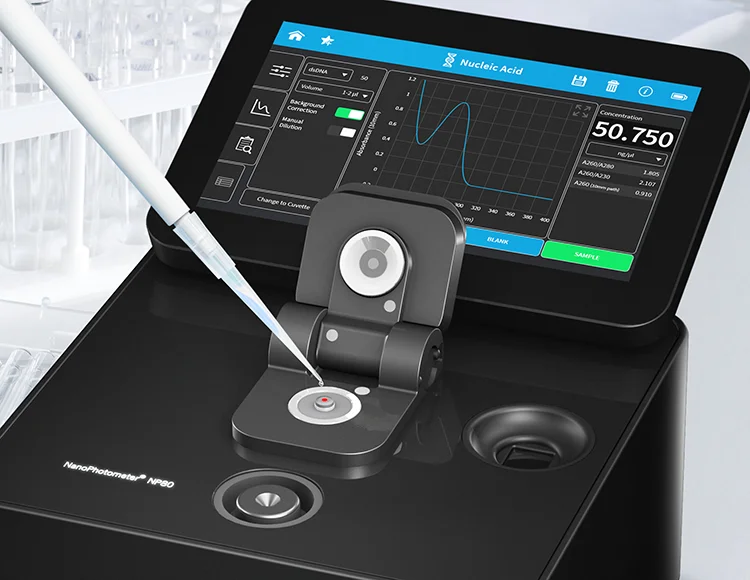
Fast, accurate RNA quantification using microvolume UV-Vis spectrophotometry.
RNA quantification using UV spectroscopy remains one of the most widely used analytical approaches in life science laboratories. It provides researchers with a rapid method to determine RNA concentration while also offering valuable information about sample purity through absorbance ratios such as 260/280 and 260/230.
By understanding how A260 measurements work, what purity ratios indicate, and what factors can affect accuracy, researchers can use UV-Vis spectrophotometry more effectively and make more informed decisions about sample quality before downstream applications. For laboratories that need a practical, fast, and information-rich method for RNA analysis, UV spectroscopy continues to be an essential tool.