
Best Practice for Nucleic Acid Quantification
Reliable nucleic acid measurements start with good technique
Preparing the instrument for accurate readings
Before measuring samples, the measurement pedestal and mirror should be thoroughly cleaned using a lint-free laboratory tissue.
Aggressive polishing should be avoided because lint particles or scratches can interfere with absorbance measurements.
Proper cleaning minimizes background interference and helps ensure stable baseline readings.
If residue on pedestal is difficult to remove using standard cleaning procedures:
- Apply approximately 5 µL of water to the pedestal
- Close the lid and allow the area to soak for at least one minute
- Wipe both the pedestal and mirror thoroughly
Use the correct blanking solution
The blank should always match the buffer used to dissolve or elute the nucleic acid sample.
For many nucleic acid applications, a recommended buffer is 10 mM Tris-HCl, pH 8.0.
After blanking, it is good practice to measure the blanking solution itself as a sample. A flat baseline confirms that the blank is clean and the optical surfaces are properly prepared.
Sample handling best practices
- Use low-binding tubes and pipette tips
- Homogenize samples before measurement
- Mix genomic DNA carefully by pipetting up and down or using a vortexer
- Confirm proper sample placement on the pedestal
- Avoid visible air bubbles during loading


Reducing Measurement Variability and Artifacts
Avoiding air bubbles and measurement artifacts
Air bubbles, lint residue, or particulate contamination can distort absorbance values and spectral profiles.
When measuring samples containing detergents such as Tween or Triton, enable air bubble recognition or similar quality-control features if available.
Reverse pipetting is often recommended for detergent-containing or foaming solutions because it reduces bubble formation during sample loading.
Measuring low-concentration samples
- Measure technical replicates
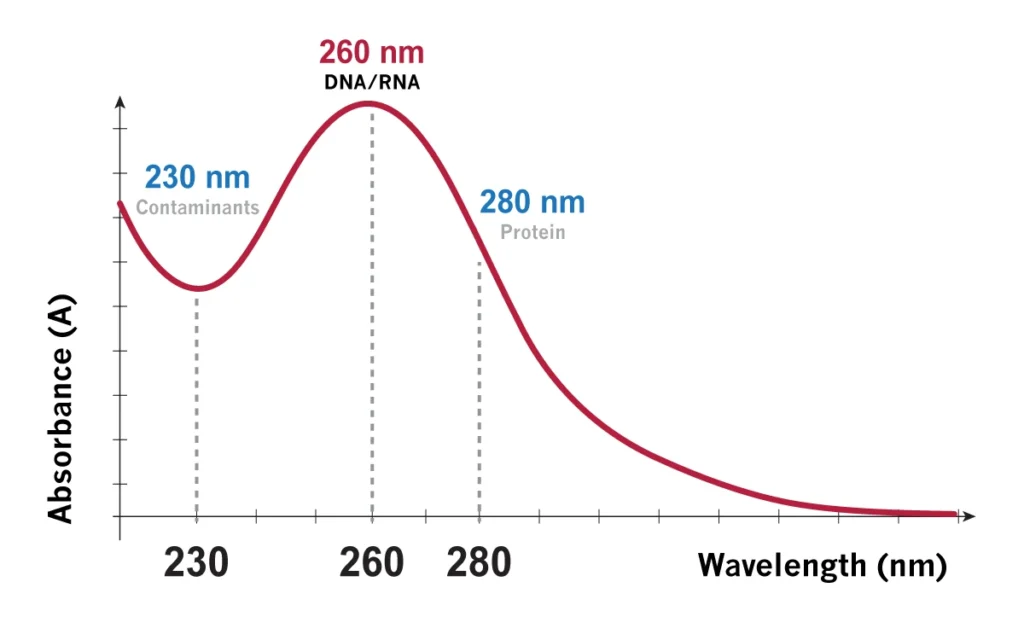
- Inspect the full spectral curve
- Review absorbance ratios carefully
- Confirm consistency across measurements
Understanding purity ratios
Common warning messages and what they mean
Air bubble or lint residue detected
Bad blank or insufficient cleaning
Sample concentration too high
Sample concentration too low
Quality control improves downstream success
Good nucleic acid quantification practices improve reproducibility and reduce downstream workflow failures. Consistent cleaning, careful blanking, proper sample handling, and thoughtful interpretation of spectra help ensure reliable concentration and purity measurements.
For sensitive applications such as sequencing, amplification, or labeling workflows, these quality-control steps can significantly improve experimental consistency and confidence in results.