
Spectral Scanning
Full Spectrum Analysis
Spectral Scanning Using UV-Vis
Spectral scanning is a powerful feature of UV-Vis spectroscopy that allows researchers to measure absorbance across a range of wavelengths rather than at a single fixed point.
Instead of focusing on one value such as 260 nm or 280 nm, spectral scanning provides a complete absorbance profile of a sample. This makes it possible to better understand sample composition, detect impurities, and evaluate overall sample quality.
By viewing the full spectrum, researchers can move beyond simple quantification and gain deeper insight into how a sample behaves across the UV-Vis range.
This page explains how spectral scanning works, when it is used, what information it provides, and how it supports more informed laboratory decisions.
What Is Spectral Scanning?
Spectral scanning is the process of measuring absorbance across a continuous range of wavelengths, typically from 200 to 800 nm.
The result is a spectrum — a curve that shows how absorbance changes with wavelength.
Different molecules produce characteristic spectral shapes. These patterns can reveal the presence of specific biomolecules or indicate whether a sample contains contaminants.
Unlike single-wavelength measurements, spectral scanning provides a more complete picture of the sample.
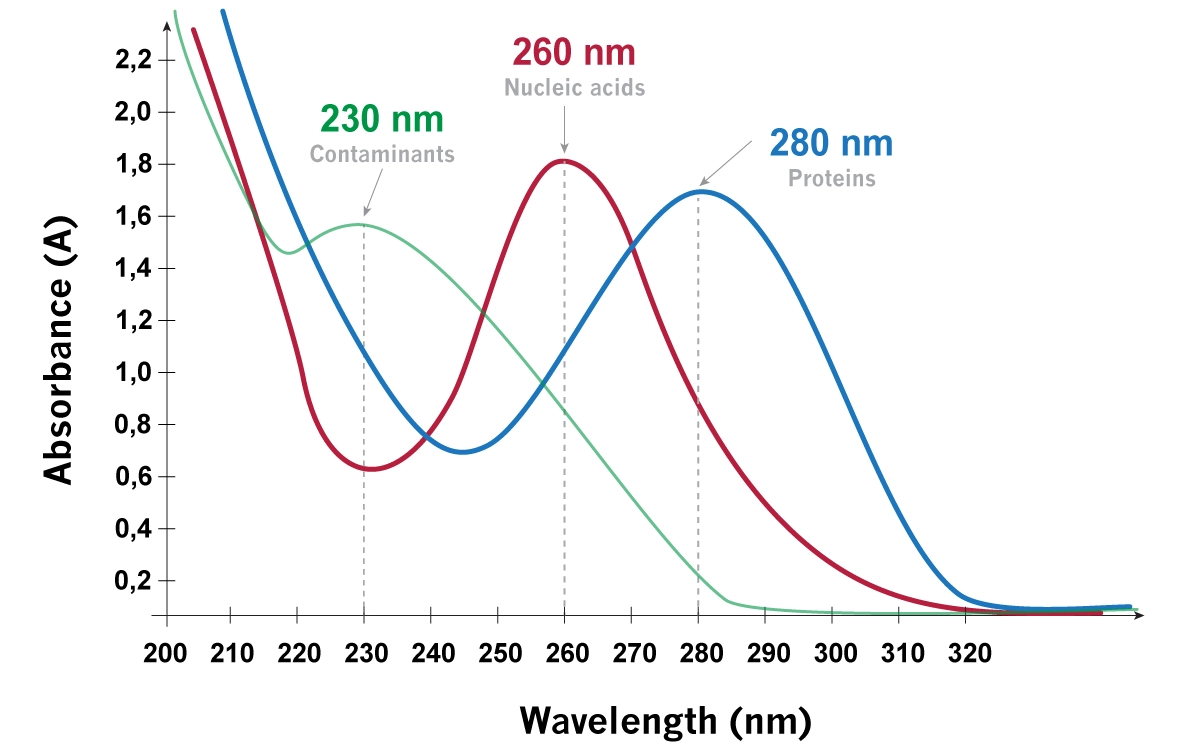
Spectral scanning measures absorbance across a range of wavelengths, producing characteristic curves that reflect sample composition and reveal differences between biomolecules and contaminants.
How Spectral Scanning Works
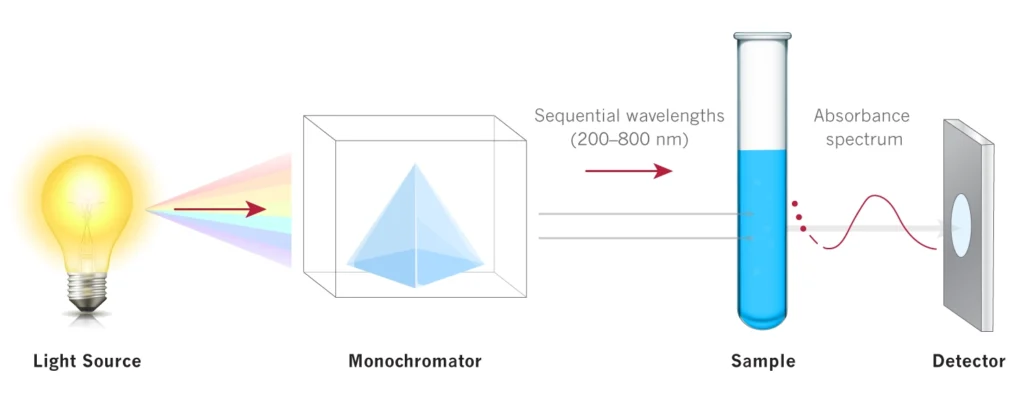
During a spectral scan, the instrument measures absorbance at many wavelengths in sequence across the selected range.
A typical scan involves:
- A light source covering the UV and visible spectrum
- A sample placed in the optical path (microvolume or cuvette)
- Sequential measurement across wavelengths
- A detector recording absorbance at each point
Comparison of cuvette path lengths. Standard 10 mm cuvettes are most commonly used, while shorter path lengths can be selected for higher concentration samples.
Understanding the Spectrum
A UV-Vis spectrum is a plot of absorbance versus wavelength.
Key features of a spectrum include:
- Peaks Regions where absorbance is highest, often corresponding to specific molecules
- Baseline The overall level of absorbance across the spectrum
- Slope or shape Changes in absorbance that may indicate impurities or background effects
For example:
- Nucleic acids show a peak near 260 nm
- Proteins show a peak near 280 nm
- Contaminants may appear at lower wavelengths (around 230 nm)
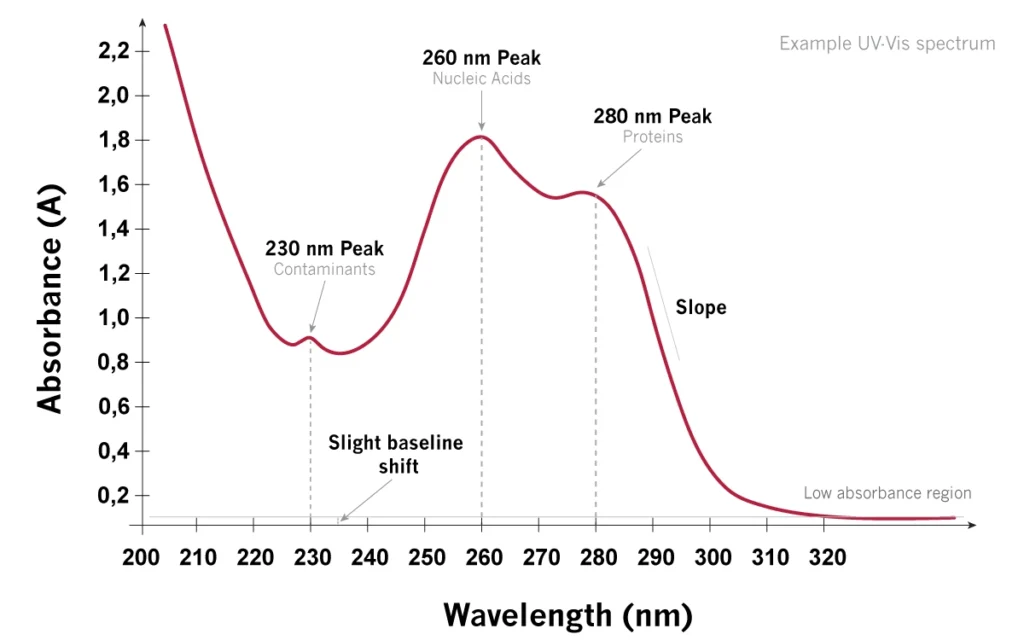
Key features of a UV-Vis spectrum include characteristic peaks, overall shape, and baseline behavior, all of which help interpret sample composition and identify potential contaminants or measurement issues.


A single number is convenient. A full spectrum tells the truth.
Why Spectral Scanning Is Useful
Spectral scanning provides information that cannot be obtained from a single absorbance value.
It allows researchers to:
- Verify that expected peaks are present
- Detect contamination or unexpected components
- Evaluate sample purity more confidently
- Identify baseline shifts or measurement issues
- Understand how different components contribute to the signal
When Spectral Scanning Is Especially Valuable
Spectral scanning is particularly useful when:
- Sample composition is unknown or uncertain
- Purity ratios alone are not sufficient
- Unexpected results are observed
- Working with complex or mixed samples
- Validating sample quality before critical experiments
What Can Affect Spectrum Quality?
Careful sample preparation and proper measurement technique are important for obtaining reliable spectra.
Several factors can influence the quality and interpretation of a spectrum:
Contaminants
Additional substances can introduce extra peaks or distort the expected shape.Improper Blanking
Incorrect baseline correction can shift the entire spectrum.Sample Turbidity
Particles or bubbles can scatter light and affect absorbance.Instrument Noise
Low signal levels can introduce variability, especially at higher wavelengths.Path Length Differences
Variations in path length can affect overall absorbance levels.Single-Wavelength Measurement vs Spectral Scanning
Both approaches are useful, but they serve different purposes.
Single-Wavelength Measurement
- Fast and efficient
- Used for routine quantification
- Focused on a specific wavelength (e.g., 260 or 280 nm)
Spectral Scanning
- Provides a full absorbance profile
- Useful for validation and troubleshooting
- Reveals additional information about sample composition

Single-wavelength measurement provides a single absorbance value, while spectral scanning captures the full absorbance profile, offering deeper insight into sample composition and quality.
Typical Workflow for Spectral Scanning
In practice, spectral scanning is easy to integrate into routine workflows:
1. Sample Preparation
The sample is prepared and mixed thoroughly.2. Blank Measurement
A blank is measured using the same buffer to establish a baseline.3. Scan Selection
The wavelength range (e.g., 200–800 nm) is selected.4. Spectral Scan
The instrument records absorbance across the selected range.5. Data Review
The spectrum is analyzed to evaluate peaks, shape, and overall quality.Applications of Spectral Scanning
Because it provides a complete view of the sample, it is a valuable tool across many workflows. Spectral scanning is used in a wide range of laboratory applications:
- DNA and RNA quality assessment
- Protein analysis and verification
- Detection of contaminants
- Method development and validation
- General sample characterization
- Troubleshooting unexpected results
Advantages of Spectral Scanning
- Provides a complete absorbance profile
- Helps identify contaminants and impurities
- Supports better interpretation of results
- Useful for troubleshooting and validation
- Enhances confidence in measurements
Recommended Instruments for Spectral Scanning
Implen spectrophotometers support full-spectrum UV-Vis scanning, allowing researchers to quickly generate and analyze absorbance spectra.
Researchers performing spectral analysis often look for instruments that provide:
- Fast full-spectrum scanning
- High signal stability
- Clear and interpretable spectral output
- Flexible wavelength selection
- Integration with routine workflows

Full-spectrum UV-Vis scanning enables rapid, high-resolution analysis of absorbance across wavelengths, supporting confident interpretation and reliable results in routine laboratory workflows.
Spectral scanning expands the capabilities of UV-Vis spectroscopy beyond simple concentration measurements. By providing a complete absorbance profile, it allows researchers to better understand their samples, detect potential issues, and make more informed decisions.
By combining spectral scanning with routine single-wavelength measurements, laboratories can achieve both speed and confidence in their analytical workflows.