
Cuvette
Measurements
Cuvette Spectrophotometry Using UV-Vis
Cuvette spectrophotometry is a widely used method for measuring nucleic acids, proteins, and other biomolecules in laboratory settings. It relies on placing a liquid sample into a cuvette with a defined optical path length, most commonly 10 mm, to determine concentration and absorbance characteristics.
UV-Vis cuvette measurements provide a reliable and standardized approach for absorbance-based analysis across a wide range of applications.
By filling a cuvette with sample and placing it into the spectrophotometer, researchers obtain accurate and reproducible measurements across the UV-Vis spectrum.
This page explains how cuvette spectrophotometry works, when it is used, what can affect measurement accuracy, and how it fits into routine laboratory workflows.
How Cuvette Spectrophotometry Works
Cuvette spectrophotometry measures absorbance by passing light through a liquid sample contained in a cuvette with a fixed optical path length. The most common standard path length is 10 mm, which provides a consistent basis for absorbance calculations using the Beer-Lambert law.
The cuvette is filled with sample and placed into the instrument. Light passes through the sample, where absorbance is measured at selected wavelengths or across the full UV-Vis spectrum.
Cuvette spectrophotometry remains a fundamental and widely trusted technique for absorbance-based analysis in life science laboratories.
Unlike microvolume techniques, cuvette measurements typically require larger sample volumes but offer a well-established and standardized measurement format.

Basic cuvette spectrophotometry principle showing light passing through a sample with a fixed optical path length before detection.


In cuvette measurements, path length is fixed — consistency comes from proper blanking and careful sample preparation.
Understanding Cuvette Path Length
Cuvette spectrophotometry is based on a fixed and known optical path length, most commonly 10 mm. This standard path length provides a consistent basis for absorbance measurements and allows direct application of the Beer-Lambert law.
Because the optical path is not adjusted during measurement, sample preparation and dilution play a more important role in ensuring that absorbance values fall within a measurable range.
In some cases, cuvettes with shorter path lengths, such as 5 mm, are used to accommodate higher concentration samples without dilution.
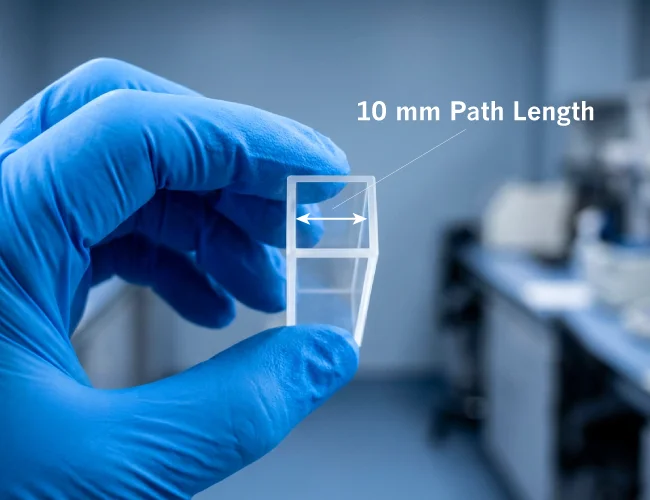
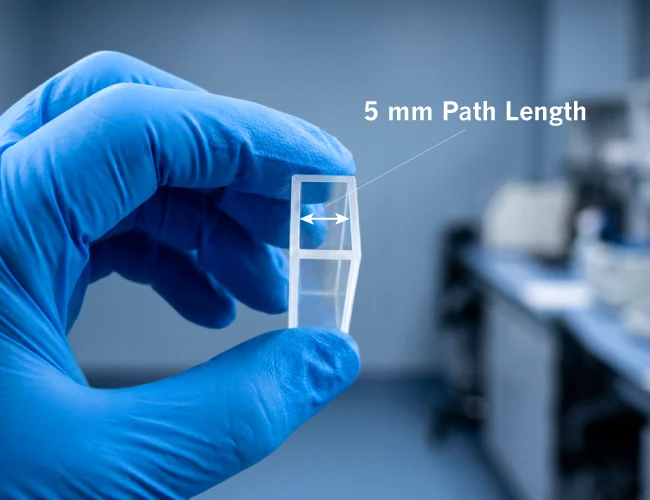
Comparison of cuvette path lengths. Standard 10 mm cuvettes are most commonly used, while shorter path lengths can be selected for higher concentration samples.
What Makes Cuvette Measurement Different?
Cuvette spectrophotometry differs from microvolume measurement in several key ways:
- Fixed optical path length (typically 10 mm)
- Requires larger sample volumes (commonly hundreds of microliters to milliliters)
- Compatible with a wide range of sample types and assays
- Well-established and standardized measurement format
- Suitable for both direct absorbance and reagent-based workflows
These characteristics make cuvette-based measurement a reliable and versatile method across many laboratory applications.
When Cuvette Spectrophotometry Is Especially Useful
Cuvette measurement is particularly valuable when researchers need:
- A standardized and reproducible measurement format
- Compatibility with assay-based workflows (e.g., Bradford, BCA, Lowry)
- Analysis of larger sample volumes
- Flexible measurement across a wide concentration range
- A familiar method used in many laboratory environments
What Can Affect Measurement Accuracy?
Although cuvette spectrophotometry is highly reliable, several factors can influence accuracy:
Improper Blanking
The blank must closely match the sample buffer. Incorrect blanking can shift absorbance values and affect results.Cuvette Quality
Scratches, fingerprints, or imperfections in the cuvette can affect light transmission and measurement accuracy.Sample Clarity
Particles, bubbles, or turbidity can scatter light and influence absorbance readings.Path Length Consistency
While cuvettes are standardized, variation between cuvettes or improper positioning can introduce variability.Contaminants
Any compound absorbing in the UV-Vis range can affect results, including salts, proteins, nucleic acids, or residual reagents.Microvolume vs Cuvette Measurements
Both microvolume and cuvette-based spectrophotometry are widely used, and each has advantages depending on the workflow.
Microvolume Measurement
- Very low sample volume (typically 0.3–2 µL)
- Fast and convenient
- No consumables required
- Ideal for routine QC and limited samples
Cuvette Measurement
- Fixed optical path length (typically 10 mm)
- Suitable for larger volumes
- Compatible with assay-based workflows
- Familiar and standardized format
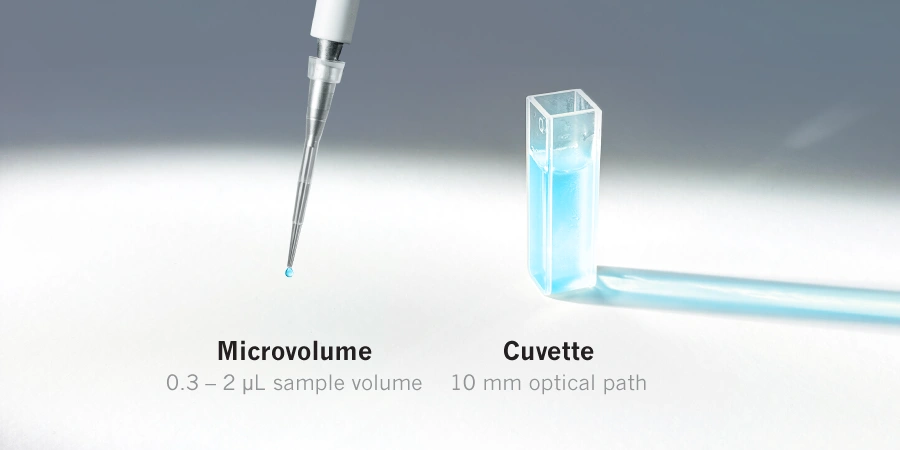
The choice between microvolume and cuvette measurement depends on sample availability, concentration range, and the type of analysis being performed.
Typical Workflow for Cuvette Measurement
In many laboratories, cuvette spectrophotometry follows a straightforward routine:
1. Sample Preparation
The sample is prepared in an appropriate buffer and mixed thoroughly.2. Blank Measurement
A blank is measured using the same buffer to establish a baseline.3. Cuvette Loading
The cuvette is filled with sample and placed into the spectrophotometer.4. Measurement
The instrument records absorbance at relevant wavelengths or across the full spectrum.5. Data Review & QC
The researcher evaluates concentration, purity ratios, or spectral features before proceeding.Limitations of Cuvette Spectrophotometry
While cuvette measurement is widely used, it has some limitations:
- Requires larger sample volumes
- May require dilution for highly concentrated samples
- Dependent on cuvette quality and handling
- Cleaning and handling can introduce variability

Applications of Cuvette Spectrophotometry
Cuvette spectrophotometry is used across a wide range of laboratory applications:
- DNA and RNA quantification
- Protein concentration measurement
- Colorimetric assays (Bradford, BCA, Lowry)
- Enzyme activity measurements
- Spectral scanning and absorbance profiling
- General laboratory quality control
Advantages of Cuvette Spectrophotometry
Cuvette spectrophotometry offers several practical advantages for routine laboratory measurements:
- Standardized path length for reproducible results
- Compatibility with many assay types
- Suitable for a wide range of concentrations
- Established and widely accepted methodology
- Flexible use across different applications
Recommended Instruments for Cuvette Spectrophotometry
Implen spectrophotometers support cuvette-based workflows with full-spectrum UV-Vis analysis and flexible measurement options.
Researchers performing routine absorbance measurements often look for instruments that provide:
- Reliable absorbance measurements with fixed path length
- Full-spectrum scanning capability
- Compatibility with assay-based workflows
- Clear and intuitive data output
- Integration into routine laboratory workflows

Cuvette spectrophotometry remains a fundamental technique for absorbance-based analysis in life science laboratories. Its standardized path length and compatibility with a wide range of applications make it a reliable choice for both routine and specialized measurements.
By understanding how cuvette measurements work, what factors influence accuracy, and when to use this method, researchers can ensure consistent and reproducible results across their workflows.