

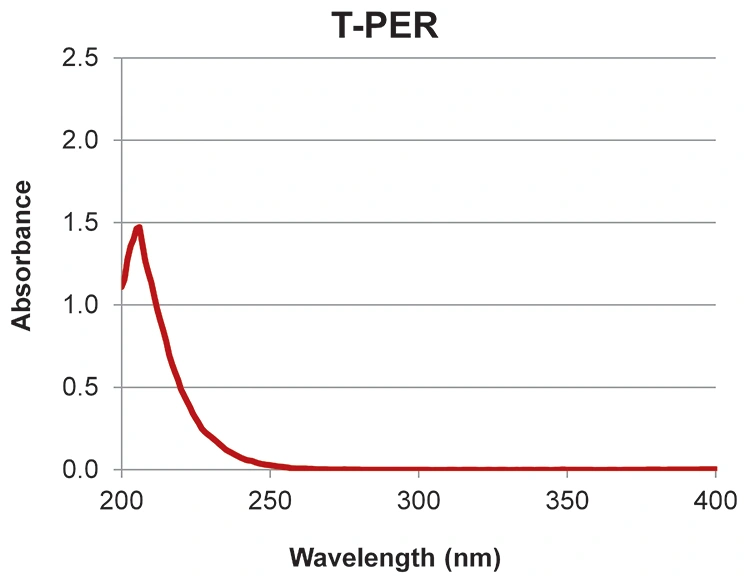
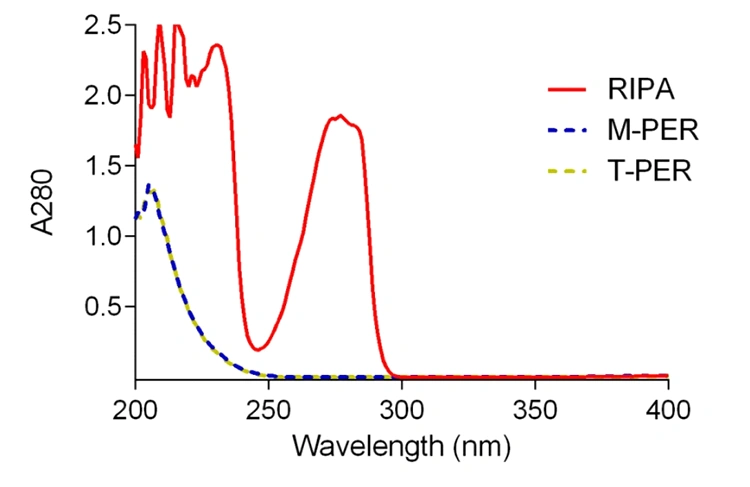
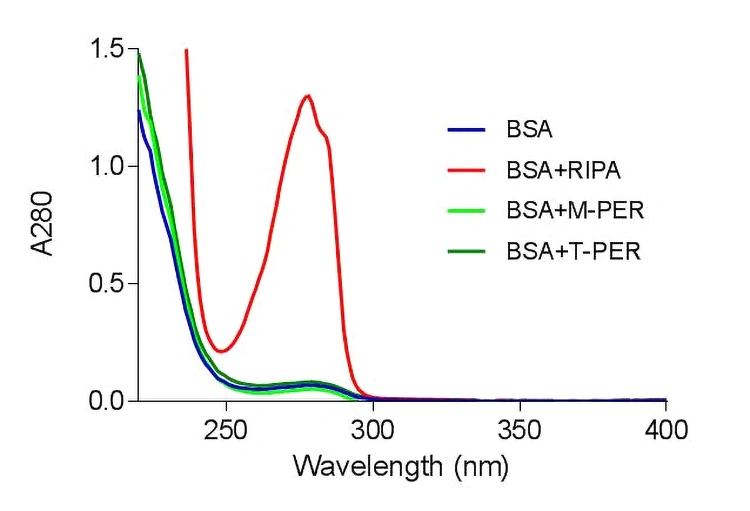



In our application note, spectral scans showed that RIPA produced a pronounced absorbance peak in the 280 nm region, while alternative extraction buffers such as M-PER and T-PER showed virtually no absorbance at 280 nm.
When RIPA was mixed with a standard BSA protein solution, the buffer significantly distorted the protein’s UV280 signal. In contrast, BSA mixed with M-PER or T-PER maintained a clean and interpretable absorbance profile.
For students and early-career researchers, this is an important practical point:
If the buffer absorbs strongly at 280 nm, the spectrophotometer cannot reliably separate protein absorbance from buffer absorbance.
As a result, protein concentrations calculated from UV280 readings in RIPA lysates can become artificially inflated, inconsistent, or highly variable.
The application note shows a comparison of protein measurements from HEK293T cell lysates prepared using RIPA, M-PER, and T-PER buffers.
Immunoblot analysis revealed that protein extraction efficiency between buffers was similar. This demonstrated that the inconsistent RIPA results were caused by UV interference from the buffer itself — not by differences in protein recovery.
RIPA buffer produces strong absorbance in the UV280 region, interfering with direct protein quantification compared to M-PER and T-PER buffers.
RIPA is also considered partially denaturing because of its detergent composition. Denaturation can expose hydrophobic regions of proteins and alter intrinsic absorbance properties, introducing another source of variability during UV measurements.
This means RIPA can interfere with UV280 quantification in two ways:
For researchers planning to use direct UV280 quantification:
Using compatible buffers allows direct UV280 measurements to remain fast, low-volume, reagent-free, and highly reproducible.