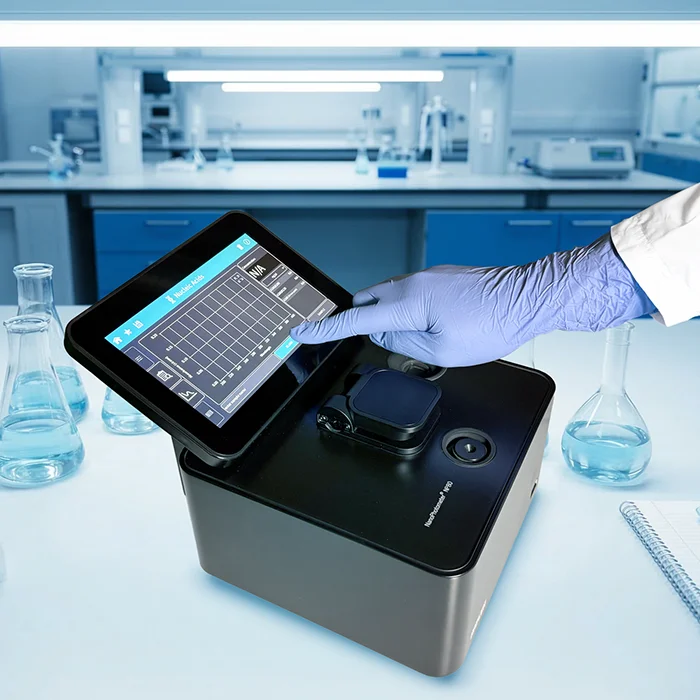
UV-Vis Spectroscopy
Absorbance & The Beer-Lambert Law
UV-Vis Spectroscopy Basics
By measuring how much light is absorbed at specific wavelengths, researchers can quickly obtain quantitative information about a sample without the need for complex preparation or reagents.
What Is UV-Vis Spectroscopy?
Different biomolecules absorb light at characteristic wavelengths:
- DNA and RNA: ~260 nm
- Proteins: ~280 nm
- Bacterial cultures (OD600): ~600 nm
This wavelength-specific behavior allows researchers to both quantify samples and assess their composition.
How UV-Vis Spectroscopy Works
-
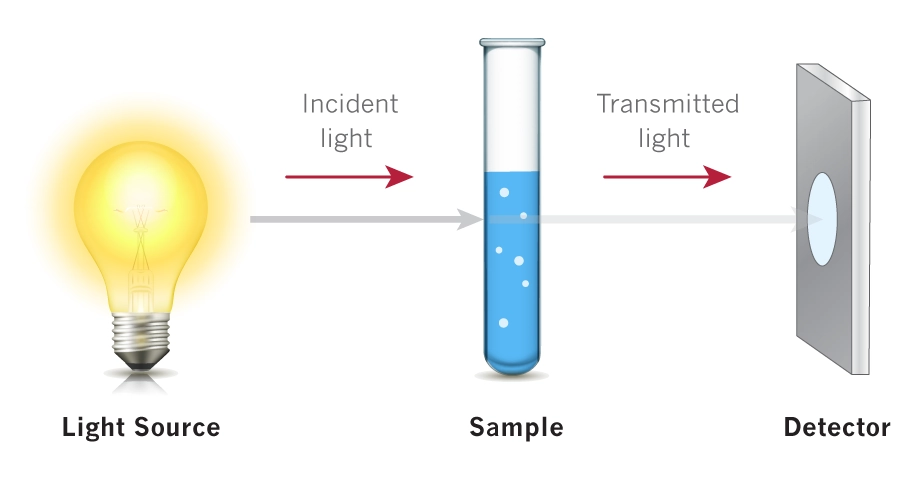
- A light source emitting a range of wavelengths
- A sample placed in the light path (cuvette or microvolume pedestal)
- A detector measuring transmitted light
- Software calculating absorbance values
Understanding Absorbance
Higher absorbance indicates that more light is absorbed by the sample, which typically corresponds to a higher concentration of the absorbing molecule.
Absorbance values are unitless and are used directly in concentration calculations.
Key Wavelengths in Life Science
Certain wavelengths are commonly used for specific measurements:
- 260 nm → nucleic acids (DNA and RNA)
- 280 nm → proteins
- 230 nm → contaminants (salts, solvents, reagents)
- 600 nm (OD600) → bacterial cell density
By measuring absorbance at multiple wavelengths, researchers can obtain both concentration and basic purity information.
Beer-Lambert Law
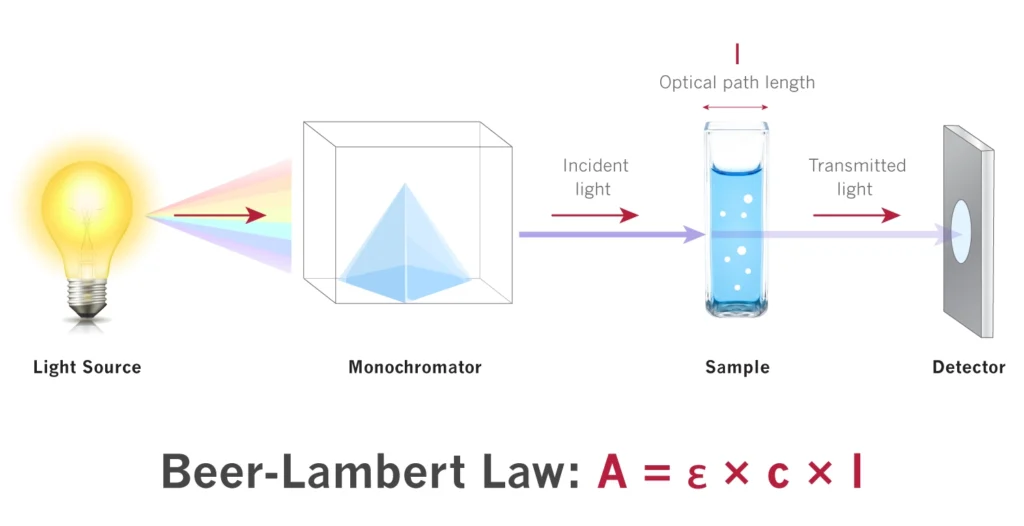
The relationship between absorbance and concentration is described by the Beer-Lambert law:
A = ε × c × l
- A = absorbance
- ε = extinction coefficient (molar absorptivity)
- c = concentration
- l = optical path length
This equation shows that absorbance is directly proportional to concentration when path length and extinction coefficient are constant.
Because of this relationship, UV-Vis spectroscopy provides a straightforward method for determining concentration in many laboratory applications.


Microvolume vs Cuvette Measurements
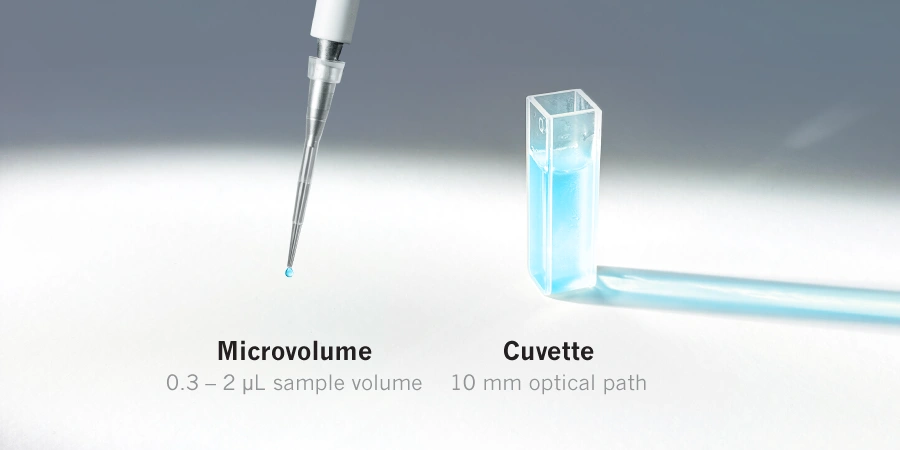
Microvolume Measurement
- Very low sample volume (typically 0.3–2 µL)
- Fast and convenient for routine workflows
- No consumables required
- Ideal for limited or valuable samples
Cuvette Measurement
- Uses larger sample volumes
- Fixed optical path length (typically 10 mm)
- Compatible with assay-based workflows
- Familiar and standardized format
What Can Affect Measurement Accuracy?
Improper Blanking
The blank must match the sample buffer to ensure accurate baseline correction.Contaminants
Substances that absorb in the UV range can affect results.Sample Quality
Turbidity, bubbles, or particulates can scatter light and influence absorbance.Path Length Differences
Inconsistent path length can affect calculated concentration.Instrument Handling
Clean measurement surfaces and proper technique are essential for reliable results.When UV-Vis Spectroscopy Is Used
- DNA and RNA quantification
- Protein concentration measurement
- Purity ratio assessment (260/280, 260/230)
- Bacterial growth monitoring (OD600)
- Colorimetric assays (Bradford, BCA, Lowry)
- General laboratory quality control
Advantages of UV-Vis Spectroscopy
- Fast and easy measurements
- No reagents required for direct absorbance
- Simultaneous concentration and purity assessment
- Applicable to a wide range of biomolecules
- Suitable for routine laboratory workflows
Recommended Instruments for UV-Vis Spectroscopy
- Reliable absorbance measurements
- Full-spectrum scanning capability
- Accurate purity ratio analysis
- Flexible measurement formats
- Clear and intuitive data output